TWM Bibliothek
Buch
Details, Verfügbarkeit und ähnliche Titel.
Buchdetails
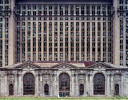
The Ruins of Detroit
von Yves Marchand, Romain Meffre, Robert Polidori, Thomas J. Sugrue
9783869300429
Steidl Dap
01.01.1970
Dieses Buch ist aktuell ausleihbar.
Komme während der Öffnungszeiten vorbei und leihe ein verfügbares Exemplar aus.
Stichwörter
Über dieses Buch
Until the 1960s, Detroit was one of America's most important cities, a hub of industry with a population of almost two million and a skyline to rival that of any U.S. city. Its buildings were monuments to its success and vitality in the first half of the twentieth century. At the start of the twenty-first century, those same monuments are now ruins: the United Artists Theater, the Whitney Building, the Farwell Building and the once ravishing Michigan Central Station (unused since 1988) today look as if a bomb had dropped on Motor City, leaving behind the ruins of a once great civilization. In a series of weekly photographic bulletins for Time magazine called "Detroit's Beautiful, Horrible Decline," photographers Yves Marchand and Romain Meffre have been revealing to an astonished America the scale of decay in Detroit. "The state of ruin is essentially a temporary situation that happens at some point, the volatile result of change of era and the fall of empires," write Marchand and Meffre. "Photography appeared to us as a modest way to keep a little bit of this ephemeral state." As Detroit's white middle class continues to abandon the city center for its dispersed suburbs, and its downtown high-rises empty out, these astounding images, which convey both the imperious grandeur of the city's architecture and its genuinely shocking decline, preserve a moment that warns us all of the transience of great epochs.
Ähnliche Bücher

Verborgene Schicksale
Ngugi wa Thiong'o

Karel Konrád und sein Roman Rozchod!
Helena Kanyar-Becker

Der lange Weg zur Freiheit
Nelson Mandela

Der Pakt
Thorkild Bjørnvig
Ancient Egyptian Gods and Goddesses
George Hart
Coiffures Traditionnelles et modernes au Mali
Mamadou Kone

Hieroglyphen
Gabriele Wenzel
Südafrika
Richard Lohmann